
How a Decades-Old Land Dispute Trapped Cruisers in Carriacou
Months after a fence severed access to Tyrell Bay Marina's slipway, international sailors remain stranded on dry land.
By Morgan Blakeman · · News
On the southwestern coast of Carriacou, the largest sister island of Grenada, Tyrell Bay Marina is widely known to cruising sailors. Today, however, the yard has become the setting for an unprecedented maritime standoff.
Since April 25, 2026, a group of international boat owners, including citizens of the United States, United Kingdom, France, Germany, and Cape Verde/Portugal, have been physically prevented from launching their vessels back into the sea.
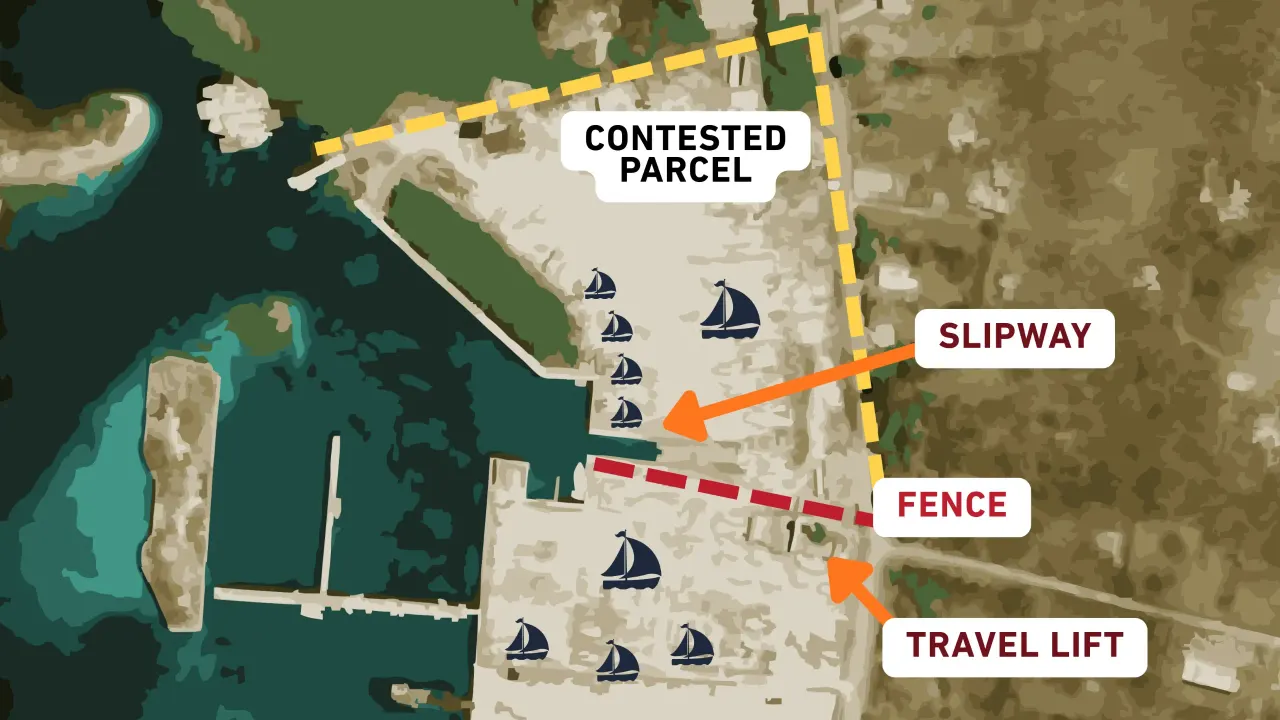
A fence erected directly through the boatyard by a local landowning family has severed the haul-out route connecting the marina's travel lift and launching slipway. The barrier has effectively imprisoned several vessels on land for almost 6 months, leaving their owners caught in a land dispute in which they have no legal standing.
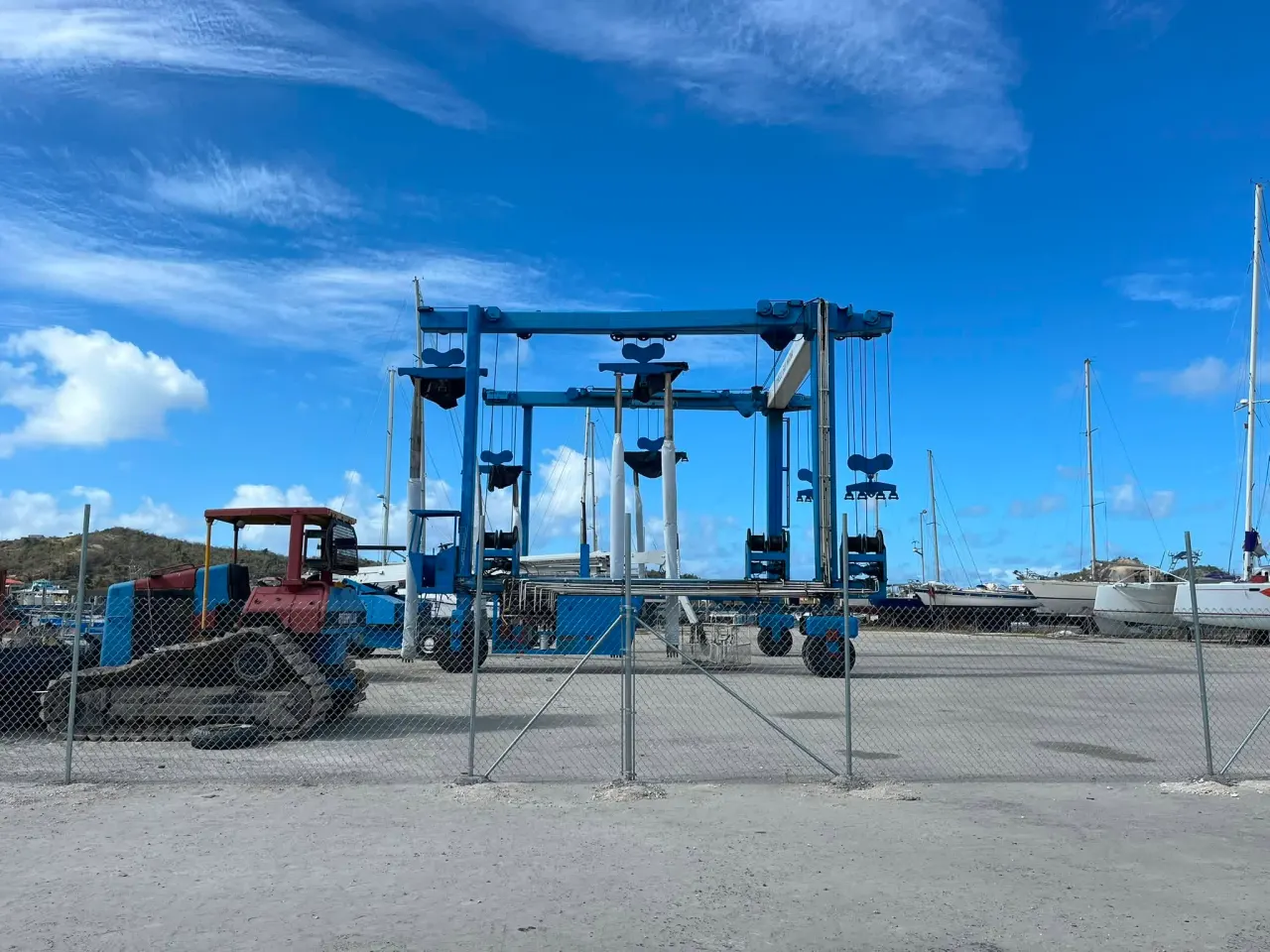
An immovable barrier on the boatyard slipway
In late April, contractors erected a fence along the border of the contested land. The barrier cuts directly across the transit path used by the yard’s 150-ton marine travel lift, through what was the middle of the boat yard.
While the marina’s travel lift and slipway remain fully operational, they are located on either side of the fence. The marina can not move the travel lift or transport vessels across the fenced line without trespassing or destroying private property. For the boat owners whose vessels sit on stands, the consequences have been debilitating.
The affected cruisers are not casual tourists staying in seaside hotels; a number live aboard full-time. For months, they have endured tropical heat, blowing boatyard dust, mosquito swarms, and rudimentary sanitation inside cabins never designed for long-term dry-dock living.
"Our vessels are our homes and, for some of us, our places of work," the trapped owners stated in an open appeal published in Grenadian media.
"Preventing us from relaunching them therefore effectively imprisons us by preventing us from leaving Carriacou."
A century-old deed and a decade-long courtroom war
The roots of the standoff date back more than a century to 1914, when the land was originally granted to Samuel Corion. The modern conflict erupted in 2013, when Carriacou Devcor Ltd (CDC), the private commercial developer behind Tyrell Bay Marina, obtained approval from the then-ruling New National Party (NNP) administration, under former Prime Minister Keith Mitchell and late Carriacou Affairs Minister Elvin Nimrod, to lease approximately seven acres of coastal mangrove land to expand the boatyard.
The heirs of Samuel Corion contested the lease, arguing that the government had leased private ancestral property without legal authority. The developers proceeded with construction, operating under the state-backed lease while the Corion Estate pursued the matter through the legal system.
On January 17, 2023, the Judicial Committee of the Privy Council in London, Grenada’s final appellate court, delivered a landmark ruling: the disputed seven acres belonged unequivocally to the Estate of Samuel Corion.
Following the verdict, the incoming National Democratic Congress administration under Prime Minister Dickon Mitchell conceded the Privy Council's decision and withdrew from the litigation against the family. However, the commercial reality on the ground remained unaddressed. While the Privy Council affirmed legal ownership of the soil, the High Court had not resolved the secondary civil battle determining commercial possessory rights, restitution for past use, or damages between the marina developers and the estate.
The landowners' stand
From the perspective of the Corion family, erecting the fence was not an act of aggression against tourists, but an overdue assertion of constitutional property rights following years of institutional abuse.
Speaking through regional press outlets, a spokesperson for the Corion Estate argued that commercial developers had operated "like cowboys" for years, backed by political patronage, making substantial commercial profits on private family land without paying a cent in rent or royalties. The family pointed out that throughout the decade-long court battle, they continued to pay municipal land taxes on the property while third parties ran a commercial marine enterprise across it.
The estate also justified the fence as a legal necessity. Under local legal counsel, the family maintained that touching, moving, or interfering directly with the boats would expose them to lawsuits for property tampering. Fencing their deeded boundary, they argued, was the only legal mechanism available to halt unauthorized commercial operations on their land.
Conflicting statements and accusations of racism
The dispute turned increasingly personal in late August when an estate spokesperson claimed in The New Today that boat owners had received advanced warning to vacate the land before the fence was erected. The spokesperson further alleged that a female family representative, Stephanie, had been met with "a condescending tone" and racially charged comments from sailors expressing disbelief that Black citizens owned the property.
The trapped cruisers issued an emphatic, collective denial. They countered that their only meeting with Stephanie occurred on site while the fence posts were already being planted, less than 48 hours before the perimeter was sealed. The sailors noted that Stephanie had exchanged telephone numbers with them and promised that an alternate gate and lifting equipment would be arranged, commitments that never materialized before communication ceased.
"These lies are extremely serious because they insinuate that we behaved in a racist and superior manner, while at the same time attempting to absolve those responsible from the fact that our boats were effectively trapped," the boat owners wrote.
They pointed to the extensive volunteer relief efforts the cruising community provided to Carriacou after Hurricane Beryl as proof of their goodwill toward the local population.
What the cruisers want
The cruisers have stressed that they are not asking the government or courts to settle the underlying and dispute. Instead, they have pleaded for a basic, temporary humanitarian compromise: remove a section of fencing, allow the marina's travel lift to splash the stranded boats, and reseal the perimeter.
Such a measure would require neither party to waive legal claims or concede property titles in the ongoing High Court case. Yet, it has not happened.
Fallout for Carriacou as a sailing hub
As the standoff enters its sixth month, the reputational damage to Carriacou’s economy is deepening. The realization that foreign-flagged yachts can be trapped on land for months behind private fences without intervention is causing cruisers to discuss bypassing Carriacou.
By refusing to decouple innocent third-party property from an ongoing commercial feud, a private property dispute has mutated into something more damaging to the regional economy, the impact of which may be felt more acutely during the 2027 hurricane season.
Open the live Risk Event Map →