
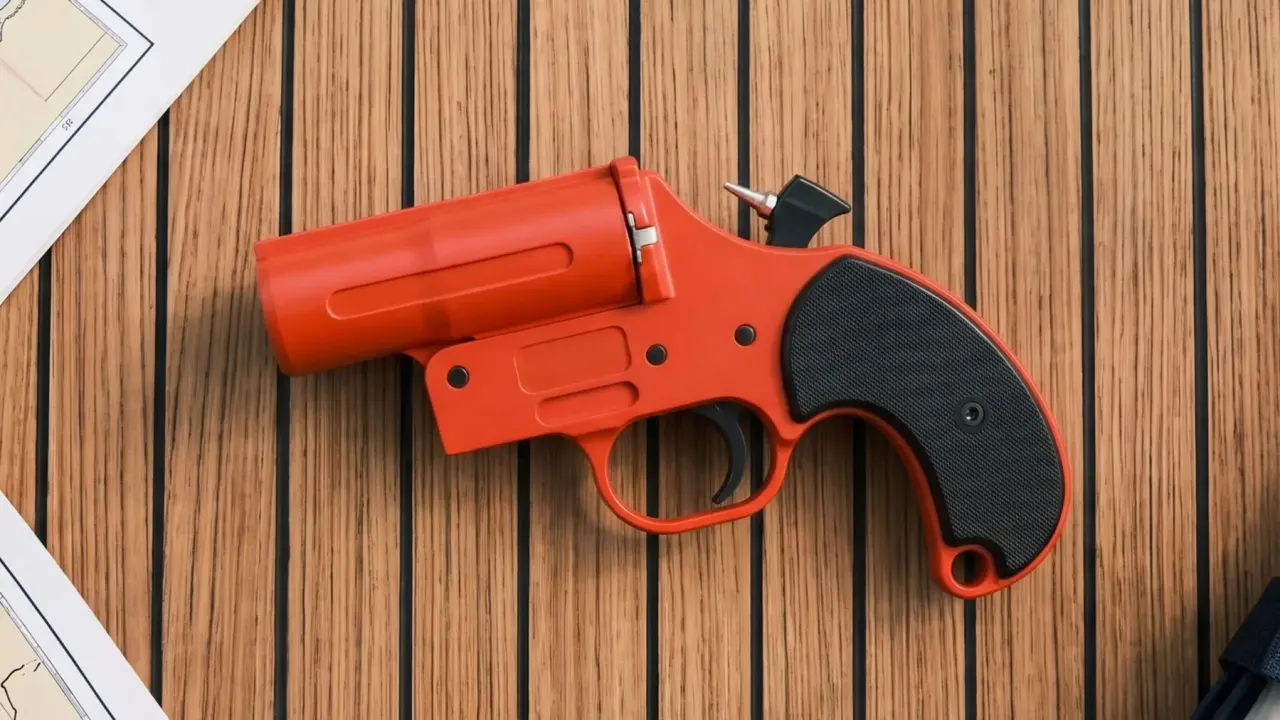
Would Shooting a Flare at a Boat Intruder Actually Work?
Cruisers often consider plastic flare guns an improvised weapon for boarding defense, but ballistic data and burn tests prove this dockside myth is flawed.
By Morgan Blakeman · · Security & Self Defence
Across anchorages from the Caribbean to the South Pacific, and around to Europe and the States, a persistent piece of advice circulates. You see it being shared online, in Facebook groups, forums and chats:
If someone boards your boat, shoot them with a flare
The theory sounds compelling on paper; an intruder boards your vessel in the dark, you fire a 2,000-degree chemical projectile, and the attacker is instantly incapacitated or sent diving overboard. However, ballistics testing and impact data paint a different reality.
The dockside myth of the improvised flare gun weapon
The idea of using a flare gun as a defensive weapon stems largely from Hollywood tropes and wishful thinking, rather than practical ballistics. In reality, a signaling flare is designed to do the exact opposite of an effective defensive round.
A defensive firearm projectile relies on dense mass, aerodynamic stability, and high velocity to transfer hydraulic shock and penetrate deep into vital organs to achieve immediate physiological incapacitation. Meanwhile, a marine flare is engineered to be as lightweight as possible, burning its chemical payload slowly over time to maximize visibility in the night sky.
When applied to self-defense, these engineering differences transform the flare gun from an intimidating deterrent into an unreliable, single-shot liability, that's more likely to start a fire than take down an intruder.
Ballistic reality: Velocity, mass and kinetic energy
Forensic testing conducted by firearms examiners and independent ballistics researchers reveals that standard 12-gauge aerial flares lack the kinetic energy necessary to physically stop a human target.
A standard 12-gauge marine cartridge contains a lightweight aluminum or plastic cup packed with strontium nitrate, magnesium, and an oxidizer. This payload weighs only 15 to 20 grams and sheds mass continuously as it burns.
Data gathered from various chronograph tests and forensic analyses underscores the performance gap between signal flares and standard weapons.
| Projectile Type | Muzzle Velocity (fps) | Projectile Weight | Kinetic Energy (ft-lbs) |
|---|---|---|---|
| Orion 12-Gauge Aerial Flare | 180 – 250 fps | ~230 grains (burning) | 35 – 60 ft-lbs |
| 9mm Luger Handgun Round | 1,100 – 1,200 fps | 115 – 124 grains | 350 – 400 ft-lbs |
| 12-Gauge 00 Buckshot | 1,200 – 1,325 fps | 538 grains (9 pellets) | 1,600 – 1,800 ft-lbs |
| Commercial PepperBall Round | 280 – 350 fps | ~45 grains | 12 – 20 ft-lbs |
With a muzzle velocity hovering around 200 feet per second, an aerial flare leaves the plastic barrel with roughly 40 to 50 foot-pounds of energy. This kinetic profile is roughly equivalent to an air rifle or energetic paintball marker. It's not going to send someone flying through the air, and they'd have to be close with a direct hit to do damage.
On top of this, marine flare guns feature short, unrifled plastic barrels without sights. Beyond point-blank range (3-6 feet), the hollow, burning projectile flies erratically through the air. In a high-stress confrontation on a rolling deck, achieving an accurate center-mass hit would be exceptionally difficult.
What physical impact testing reveals
Putting the numbers aside, there have been many who have done actual tests using ballistic dummies and random items, shooting them at close range with a flare gun. Some have been shared on YouTube.
12-GAUGE ORION FLARE GUN TEST
In this video, Paul Harrell tests a 12-gauge Orion flare gun to determine its effectiveness for self-defense. His demonstration includes shooting flares at a target, and exploring the safety risks of loading conventional ammunition into the flare gun.
ANALYSIS THAT INCLUDES A REAL-LIFE INCIDENT
Tom Grieve, a former state criminal prosecutor from Wisconsin, analysed a real-world case where an elderly lady shot her neighbor in the face with a flare gun. While his opinions may not be for everyone, seeing how this incident played out and the resulting damage is an interesting case study.
DISTANCE MAKES A DIFFERENCE
Obviously the closer you are to the target, the more potential there is for a flare gun to do damage. 1ShotTV demonstrates this using a flare gun and ballistic dummy, shooting it at various distances including point blank.
These videos help highlight a few problems worth considering:
- It's difficult to aim a flare accurately in the middle of the day on land, let alone at night on a moving deck
- Flares have a tendency to ricochet in random directions, including back at you
- You have to get very close to an intruder for there to be an effect
- An attacker fueled by adrenaline, alcohol, or narcotics can retain full muscle mobility and motor function for minutes following a thermal burn injury
Whatever self-defense strategy you ultimately decide on, you want it to be based in reality, which is why considering these points is important.
Ricochets and vessel fires
One of the greatest flaws in the flare gun defense strategy is the risk it poses to the defender's own vessel. Most boats are a concentrated collection of highly combustible petroleum-based materials; polyester resin, fiberglass hulls, vinyl cockpit cushions, acrylic canvas dodgers.
If the flare ricochets off something, back into your boat, the results could be catastrophic.
So, is shooting a flare at an intruder a good self-defense plan?
In general, it seems not. The risk of setting your boat alight, combined with the limited efficacy of a low-energy, inaccurate, single-shot projectile, means it’s generally best to leave the flare gun for what it’s meant to be used for; a signalling device to call for immediate help. Treating it as a cockpit shotgun is more of an illusion that could put your crew, your boat, and your life at severe risk.
When formulating your self-defense strategy, make sure you consider simple preventative measures, like checking for Risk Reports before you sail, locking doors and hatches at night and installing security cameras, along with ear-piercing sirens, high-power searchlight and long-range pepper spray.
Share your thoughts on boat security
Cruising safely requires separating dockside folklore from proven safety practices. What non-lethal security measures have worked best on your vessels? Have you had a boarding attempt, in which case what happened, and what can others learn from your experience?
To stay updated on the latest security alerts and hazard reports in your area, or to report an incident yourself, visit the WAKETRACE map.
Open the live Risk Event Map →