
PAN-PAN, MAYDAY, SÉCURITÉ or BOLO?
Knowing the right VHF call saves lives. Discover the rules behind Mayday, Pan-Pan, Sécurité, and BOLO calls to handle boat emergencies with confidence.
By WAKETRACE Team · · Seamanship
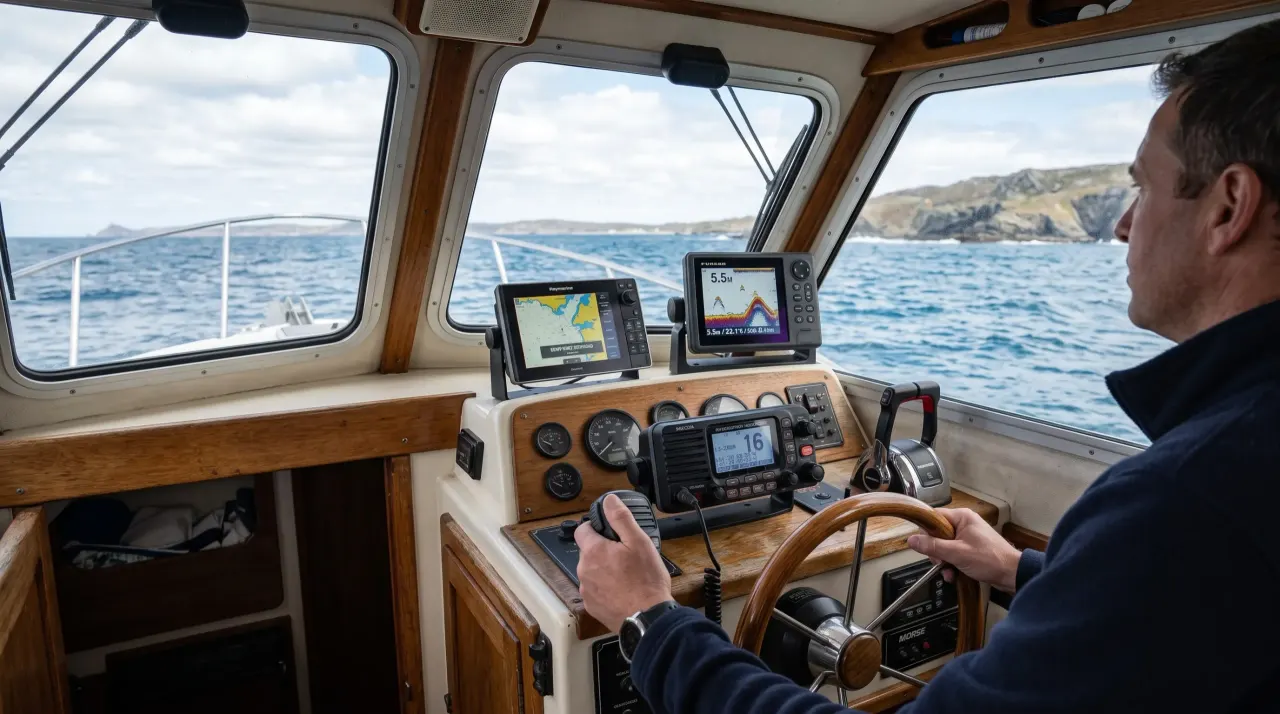
A marine VHF radio is one of the most important safety tools aboard a vessel, but knowing how to use it properly during a crisis is what saves lives.
International maritime agreements establish a strict priority order for radio traffic to ensure that life-threatening distress calls always get through first. Understanding the boundaries between MAYDAY, PAN-PAN, SÉCURITÉ, and a BOLO notice allows skippers to summon the right level of help without tying up critical rescue resources.
The maritime communication hierarchy at a glance
International maritime law organizes emergency radio communications into a three-tier priority system based on the level of danger to human life and the vessel. The three recognized distress and safety calls, MAYDAY, Pan Pan, and Sécurité, are broadcast on VHF Channel 16, or 2182 kHz on medium frequency radios. A BOLO operates outside this formal radio treaty system, as an informational alert used by law enforcement and cruising networks.
| Call | Meaning | Typical Trigger |
|---|---|---|
| MAYDAY | Distress (Highest Priority) | Sinking, major fire, crew lost at sea |
| PAN-PAN | Urgency (Second Priority) | Disabled engine, broken bone |
| SÉCURITÉ | Safety (Third Priority) | Storm warnings, navigation hazards |
| BOLO | Information / Law Enforcement | Stolen tenders, wanted suspects, missing yachts |
MAYDAY
A MAYDAY call is reserved exclusively for situations involving grave and imminent danger to life or the vessel, requiring immediate assistance. Originating from the French phrase m'aider, meaning help me, this distress call overrides every other transmission on the airwaves.
Skippers should only transmit a MAYDAY during catastrophic events such as an active sinking, an uncontrolled fire, an armed attack, or a life-threatening medical emergency. If equipped with a DSC radio, transmit your digital distress alert before making the MAYDAY voice call:
- State the emergency: “MAYDAY, MAYDAY, MAYDAY”
- State the vessel name: “This is [Vessel Name], [Vessel Name], [Vessel Name]”
- State the callsign and MMSI: “Callsign [Callsign], MMSI [9-digit MMSI]”
- Repeat vessel identity: “MAYDAY, [Vessel Name]”
- Give the vessel’s position: Latitude and longitude, or bearing and distance from a known landmark
- State the nature of distress and assistance required (e.g., taking on water, immediate evacuation needed)
- Provide vital details: Number of persons on board (POB), vessel description, deployable liferafts or dinghies
- End transmission: “Over”
Once a MAYDAY is active, all other stations must maintain radio silence unless directly assisting with the rescue.
Pan-Pan
A PAN-PAN call signals an urgent situation concerning the safety of a vessel or person where life is not in immediate, grave danger. Derived from the French word panne, meaning breakdown or mechanical failure, PAN-PAN handles serious problems that could escalate if left unaddressed.
Common reasons to issue a PAN-PAN include complete engine failure while drifting or an overdue vessel where there is significant concern for the crew's safety. For a practical look at how these scenarios play out, you can read one cruisers reflection on their midnight rescue at noforeignland Magazine.
To make a PAN-PAN call:
- Broadcast “PAN-PAN, PAN-PAN, PAN-PAN” on Channel 16.
- Identify your vessel, state your position, and describe the problem.
Rescuers or the Coast Guard will instruct you to shift to a working channel to keep Channel 16 clear for active distress calls.
SÉCURITÉ
A SÉCURITÉ call broadcasts vital safety messages, primarily regarding navigational hazards or severe weather alerts. Drawn from the French word for safety, mariners regularly use SÉCURITÉ to report semi-submerged shipping containers, unlit derelict boats, or sudden visibility drops in high-traffic channels. Coastal stations and coast guards also announce gale warnings and storm advisories.
To issue this alert, the captain broadcasts “SÉCURITÉ, SÉCURITÉ, SÉCURITÉ” on Channel 16 to alert nearby traffic, announces the general nature of the hazard, and instructs listening stations to switch to a specified working frequency to receive the exact coordinates and details.
BOLO
A BOLO (Be On the Lookout) is an administrative alert used by law enforcement, port authorities, and safety platforms, rather than an internationally treaty-backed distress word.
Police agencies, coast guards, and civilian networks like WAKETRACE may issue BOLOs when maritime property is stolen or a missing vessel needs to be found. A typical maritime BOLO provides the physical characteristics of a vessel, such as a stolen Hinckley sailboat, or details regarding a person authorities are attempting to locate.
Rather than cluttering emergency distress channels, BOLOs are usually circulated during scheduled Coastal Marine Information Broadcasts, over morning cruiser VHF nets, and across online maritime safety networks or social media. Mariners who spot a vessel named in a BOLO are usually asked to report its position directly to local police or Coast Guard authorities.
Common radio mistakes and best practices
Misusing emergency radio calls or failing to follow standard transmission rules can delay rescue operations and create dangerous radio congestion. One common mistake is calling a full Mayday for minor problems, like running out of fuel in calm weather when an anchor can be dropped safely. Conversely, some skippers wait far too long to call PAN-PAN, allowing an urgent situation to deteriorate into a life-threatening disaster before seeking assistance.
For recreational boaters, it's a good idea to keep a laminated VHF script next to the radio station so any crew member or even a passenger can read off the required information under stress. If an emergency beacon or Mayday is triggered accidentally, the skipper must immediately broadcast a voice cancellation on Channel 16 to prevent resources being mobilized for a false alarm.
Making the right call
Clear communication at sea is one of the cornerstones of good seamanship, and knowing which call to make ensures the maritime safety-net works as intended.
Share your onboard radio setups and safety habits in the comments, as well as any lessons learned through real-life experiences that could help others as they undertake their own boating adventures.
Open the live Risk Event Map →